Legitimize Russia's ZNPP Occupation
This PSYOP aims to shift blame for nuclear safety risks at the Zaporizhzhia Nuclear Power Plant from Russia to Ukraine, thereby legitimizing Russia's continued occupation. Russia benefits by normalizing its control over the plant and deflecting international criticism.
Executive Summary
Power Patterns
Manufacturing Casus Belli
The PSYOP manufactures a casus belli by framing Ukraine's actions as posing an existential nuclear threat, justifying Russia's continued occupation of ZNPP as a necessary safety measure. It scapegoats Ukraine for potential nuclear incidents, displacing blame from Russia's initial seizure and ongoing militarization of the plant. The narrative also subtly leverages eschatological undertones by invoking the specter of Chornobyl, a deeply traumatic event, to mobilize fear and support for Russia's 'protective' role.
Cui Bono — Who Benefits?
Russia benefits by legitimizing its occupation of the Zaporizhzhia Nuclear Power Plant, reducing international pressure for its withdrawal, and deflecting blame for nuclear safety risks onto Ukraine. This narrative enables Russia to maintain strategic control over a vital energy asset and a significant piece of Ukrainian territory, while simultaneously portraying itself as a responsible actor preventing a nuclear disaster.
Historical Parallels
Iraqi WMDs (2002-2003)
Similar to the Iraqi WMD narrative, this PSYOP uses the specter of a catastrophic threat (nuclear disaster) to justify military presence and actions, despite a lack of independent evidence supporting the claims against the targeted entity (Ukraine).
The Reichstag Fire
The framing of Ukraine's actions as reckless and dangerous, potentially leading to a nuclear catastrophe, resembles the Reichstag Fire in its use of a manufactured or exaggerated threat to justify extraordinary measures and suppress opposition (in this case, international pressure on Russia).
Narrative Mechanics
Synchronized Talking Points
“Ukraine's actions near ZNPP are reckless and risk nuclear catastrophe (cbc.ca, npr.org, japantimes.co.jp).”
“Russia's presence at ZNPP is for safety and protection (rt.com).”
“Ukraine is targeting Russian civilians and infrastructure with drones (france24.com, npr.org, cbsnews.com, timesofindia.indiatimes.com, bbc.com, aljazeera.com, smh.com.au).”
“Ukraine is using neo-Nazis and recruiting minors for terrorism (rt.com).”
Framing Evolution
Initially, the narrative focused on Russia's seizure of ZNPP as a military act. This PSYOP evolves the framing by shifting from Russia as the aggressor to Russia as the protector, responding to Ukrainian 'recklessness' and 'terrorism.' The focus has moved from the initial act of occupation to the ongoing 'threat' posed by Ukraine to the plant, thereby justifying Russia's continued presence. The inclusion of North Korean involvement and German-Ukrainian 'deep strike' capabilities in some articles, particularly from RT, attempts to broaden the narrative of Ukrainian aggression and its international support.
Suppressed Counter-Narratives
×Russia's initial military seizure and militarization of the ZNPP as the primary source of nuclear risk.
×Independent verification of Ukrainian actions near ZNPP and their actual threat level.
×The impact of Russian shelling and military operations on the plant's safety systems.
×The illegality of Russia's occupation under international law.
Outlet Coordination
Russian state media outlets like RT.com are the primary drivers of the explicit 'Russia as protector, Ukraine as reckless' narrative, often using highly charged language and unverified claims. Western outlets (cbc.ca, npr.org, france24.com, smh.com.au, cbsnews.com, japantimes.co.jp, aljazeera.com, bbc.com, theglobeandmail.com, timesofindia.indiatimes.com) contribute to the broader context by reporting on Ukrainian drone strikes on Russian territory, civilian casualties from Russian attacks, and the general fear of nuclear disaster, which, while factually reported, can inadvertently feed into the Russian narrative of a dangerous, escalating conflict where Ukraine is also an aggressor. The speed and similarity of reporting on Ukrainian drone strikes across multiple Western outlets, often emphasizing casualties and damage in Russia, suggest a degree of synchronized narrative around Ukraine's offensive capabilities, even if not explicitly endorsing the Russian ZNPP narrative.
Bigger Picture
This PSYOP is part of Russia's broader strategy to legitimize its territorial gains and military actions in Ukraine, particularly regarding critical infrastructure. By framing itself as a responsible actor preventing nuclear catastrophe, Russia seeks to erode international support for Ukraine and normalize its occupation of Ukrainian territory, fitting into a larger pattern of civilizational resistance against perceived Western hegemony.
Prediction
This PSYOP is likely building toward a sustained international acceptance of Russia's control over ZNPP, potentially leading to a reduction in demands for its withdrawal and a shift in focus towards 'managing' the nuclear risk under Russian stewardship. It prepares the public for a scenario where Russia's occupation is seen as a necessary evil to prevent a greater catastrophe, rather than the cause of the risk itself.
Intelligence Coverage

Normalize Ukraine AI Warfare: Coordinated Push to Legitimize Autonomous Combat Systems
A coordinated narrative campaign has emerged to normalize Ukraine’s use of AI-driven drone warfare, reframing it as an inevitable evolution of modern combat....
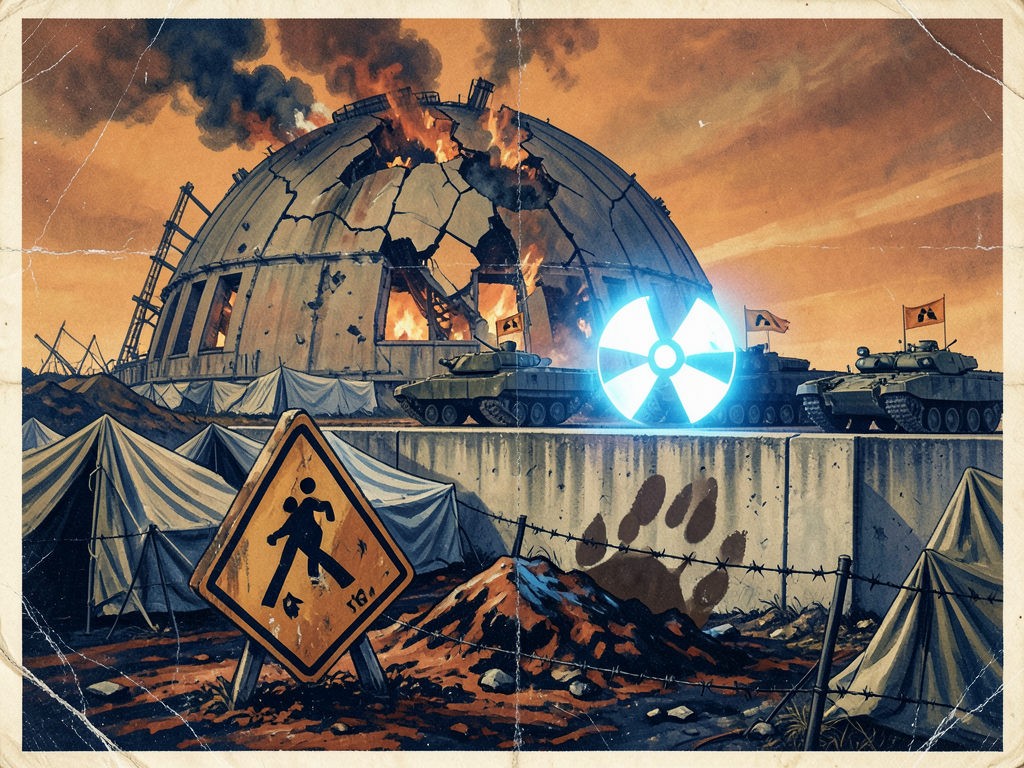
Detected PSYOP: Justify Russian Nuclear Occupation
A coordinated narrative effort has been identified from April 28 to May 14, 2026, designed to reframe Russian control of the Zaporizhzhia Nuclear Power Plant...
Detected PSYOP justifies Russian occupation of Zaporizhzhia nuclear plant
A coordinated narrative has been detected that reframes Russian occupation of the Zaporizhzhia Nuclear Power Plant as a necessary stabilizing force. This mes...

Normalizing AI Warfare in Ukraine Serves Western Military and Industrial Interests
A coordinated narrative has emerged across multiple international outlets between April 18, 2026, and May 1, 2026, promoting the adoption of AI-driven roboti...
Manufacture Russian Casus Belli Narrative Escalates in Western Media
A coordinated narrative intensifying the framing of Ukrainian strikes on Russian territory as aggressive, escalatory acts has emerged across 18 articles in e...

Sanitize North Korean Combat Deployment Psyop Observed Across Pro-Russian Outlets
A coordinated narrative emerged on April 26, 2026, across three outlets—The Globe and Mail, RT, and Yonhap News Agency’s English service—framing North Korean...
Detected PSYOP: Sanitize North Korean Combat Deployment in Ukraine
A coordinated narrative has emerged to legitimize and valorize North Korea’s military deployment in Ukraine on behalf of Russia. The PSYOP, detected across f...

Manufacture Russian Casus Belli: Coordinated Narrative Reframes Ukrainian Strikes as Aggression
A coordinated narrative has emerged across Western and Russian state-aligned media normalizing Ukrainian cross-border attacks on Russian energy infrastructur...
Manufacture Russian Casus Belli Detected in Coordinated Media Push
On April 17, 2026, a coordinated narrative emerged across four media outlets—BBC, CBS News, CBC, and RT—advancing a synchronized framing of Russian military ...
Sources & Articles
2026-07-15T20:43:49.000Z
May 18, 2026
May 10, 2026
May 17, 2026
May 18, 2026
May 18, 2026
Showing 10 of 74 articles
External Coverage(50)
Showing 10 of 50