Legitimize French Nuclear Hegemony
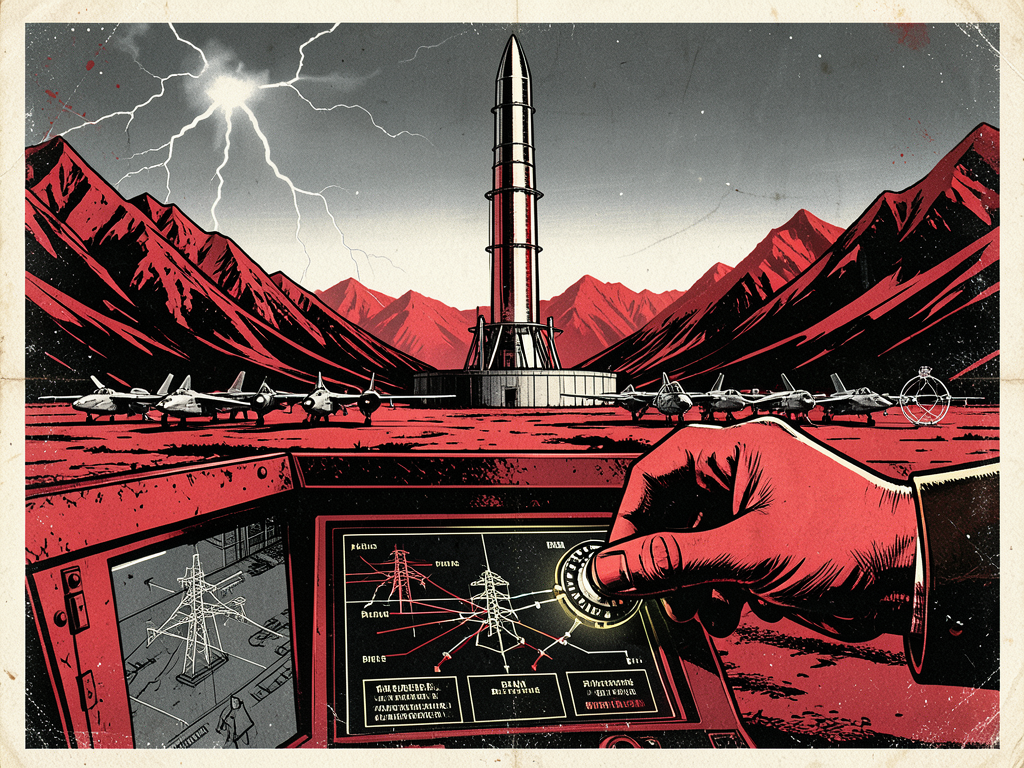
This PSYOP normalizes France's expanded nuclear capabilities and leadership in European defense, building public acceptance for increased French military spending and a more assertive foreign policy. It primarily benefits the French government, its military-industrial complex, and President Macron by positioning France as the indispensable guarantor of European security.
Executive Summary
Power Patterns
Religious Legitimation of Power
The narrative uses 'European security' and 'defense against threats' as the legitimating framework for France's nuclear expansion, presenting it as a rational, necessary response to external dangers. This framing manufactures a casus belli by emphasizing threats from Russia and Iran, justifying increased military capabilities. It also subtly supports French imperial overextension by positioning France as the natural leader of a unified European defense, potentially beyond its current capacity.
Cui Bono — Who Benefits?
The French government and President Macron benefit by enhancing France's geopolitical standing and leadership within Europe, bolstering their domestic political capital. The French military-industrial complex benefits from increased demand for nuclear weapons and related defense technologies. This narrative enables them to secure public and political support for higher defense budgets and a more assertive French foreign policy, while also potentially strengthening NATO by presenting a more capable European pillar, albeit one led by France.
Historical Parallels
Iraqi WMDs (2002-2003)
Similar to the WMD narrative, this PSYOP uses a perceived 'threat' (Russia, Iran) to justify a pre-determined military expansion (French nuclear arsenal), with media amplifying the threat and presenting the response as necessary and rational.
The Humanitarian Intervention Template (Libya 2011, Syria 2011-present)
While not directly about intervention, the framing of France's nuclear expansion as a 'responsible' and 'defensive' measure for 'European security' echoes how interventions are often justified, using broad, positive terms to mask underlying power plays and potential escalations.
Narrative Mechanics
Synchronized Talking Points
“France is leading European defense efforts.”
“European nations are stepping up to strengthen their own defense.”
“The expansion of nuclear deterrence is a necessary response to geopolitical pressures/threats (from Russia, potential US disengagement).”
“French nuclear initiatives are responsible, cooperative, and enhance continental security.”
“The goal is to make Europe 'feared' and thus 'free'.”
Framing Evolution
The initial reporting, as seen in france24.com, is largely factual about agreements and statements. However, outlets like ynetnews.com and theguardian.com escalate the framing by emphasizing 'expansion' and 'warnings of border flare-up,' portraying Macron as a strong leader responding to urgent threats, and explicitly linking the nuclear build-up to making Europe 'feared.' This shifts from reporting a policy to advocating for its necessity and positive implications.
Suppressed Counter-Narratives
×The potential for an arms race or nuclear proliferation in Europe.
×Concerns from non-nuclear European states or those wary of French dominance.
×Alternative diplomatic or non-military approaches to European security.
×The financial costs and opportunity costs of increased nuclear spending.
×Internal disagreements within NATO or the EU regarding France's leadership role.
Outlet Coordination
France24.com provides a relatively straightforward news report (score 29/100). Foxnews.com (36/100) presents a slightly more amplified but still somewhat balanced view. However, ynetnews.com (58/100) and theguardian.com (50/100, 60/100) push hardest on the PSYOP elements, using more dramatic language, emphasizing threats, and framing France's actions as unequivocally positive and necessary. The Guardian articles, in particular, use strong, almost propagandistic language like 'make Europe feared' and 'vital for European security' without critical examination.
Bigger Picture
This PSYOP fits into a broader geopolitical landscape where European powers, particularly France, are seeking greater strategic autonomy and leadership, partly in response to perceived US unreliability and ongoing tensions with Russia. It's an attempt to redefine the power balance within NATO and the EU, positioning France as the primary security guarantor for the continent, potentially challenging Germany's economic leadership and the traditional US security umbrella.
Prediction
This PSYOP is likely building toward public acceptance of significantly increased French military spending, particularly on nuclear capabilities, and a more assertive French foreign policy in Europe. It prepares the public for France taking a more dominant role in European defense, potentially leading to greater integration of European military forces under French leadership and a reduced reliance on the United States for security.
Sources & Articles
Mar 3, 2026
May 28, 2026
Mar 3, 2026
External Coverage(50)
Showing 10 of 50