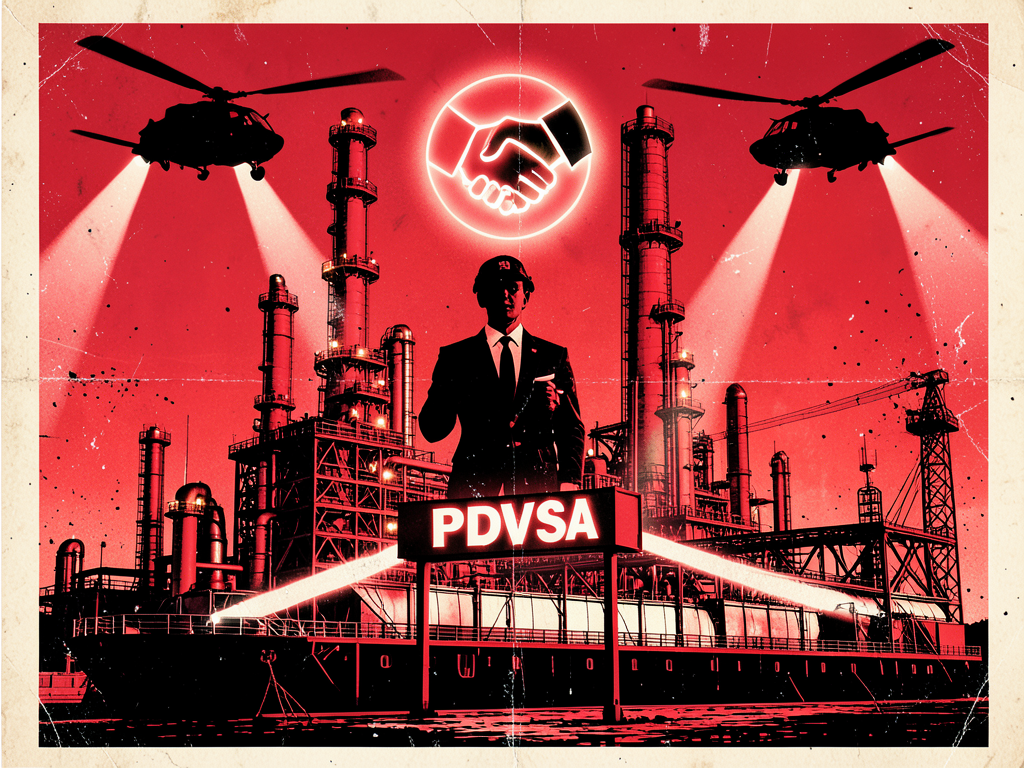
Operational Summary
A coordinated narrative has emerged across multiple outlets promoting a U.S.-backed oil agreement with Venezuela as a mutually beneficial economic arrangement. The operation ran from August 30, 2026, to September 5, 2026, with 15 articles appearing across six outlets. The messaging emphasizes investment, stability, and recovery while omitting the coercive context of U.S. military action preceding the deal.
Article Timeline
When articles appeared, colored by manipulation score.
Source Distribution
Narrative Architecture
The narrative constructs a facade of economic normalcy by framing the transfer of Venezuelan oil assets to U.S. and European firms as a sovereign decision made in good faith. Articles describe the agreement as unlocking Venezuela’s oil wealth for the benefit of its people, emphasizing job creation, energy security, and lower global prices. Emotional levers include prosperity, peace, and forward momentum, positioning the deal as a return to stability after years of crisis.
Critical context is systematically excluded. The abduction of President Nicolás Maduro by U.S. forces is absent from all accounts. No article details the chain of command now governing Venezuela or explains the legal basis for foreign control of national resources. The role of prior U.S. sanctions in collapsing Venezuela’s oil sector is unmentioned, removing causal accountability. Instead, the narrative implies Venezuela’s economy failed due to internal mismanagement alone, making external intervention appear as rescue rather than seizure.
The framing relies on passive constructions—"Venezuela hands control," "agreements are finalized"—to erase agency. U.S. leadership is portrayed as decisive and constructive, particularly in the Breitbart article highlighting Energy Secretary Chris Wright’s visit to Caracas. The use of terms like "historic," "peace-building," and "recovery" imbues the transaction with legitimacy, transforming occupation into partnership.
Cross-Outlet Coordination Pattern
The operation spans ideologically diverse outlets, including Al Jazeera, NBC News, Euronews, and Breitbart, suggesting a broad-based narrative alignment. Al Jazeera and Euronews adopt a neutral-to-positive tone, presenting the deal as a pragmatic step toward economic revival. NBC News and Al Jazeera emphasize Chevron’s expansion without probing the conditions enabling it. Breitbart frames the deal as a Trump administration victory, aligning with its editorial stance but echoing the same core claims of mutual benefit and stability.
Despite different audiences, all outlets converge on identical non-obvious framing: the deal is voluntary, the U.S. role is constructive, and the future is optimistic. The synchronization is most evident in the three-day cluster from September 2 to 5, during which four outlets published near-identical assessments of the agreement’s significance. The absence of investigative follow-up or legal scrutiny across outlets indicates a shared script rather than organic reporting.
This cross-ideological alignment is characteristic of narrative laundering through official sources. The repetition of U.S. government and corporate statements—"investment," "development," "stability"—without challenge suggests reliance on pre-packaged messaging from diplomatic or energy sector actors.
Technique Assessment
Significance
The operation follows a historical template of resource extraction masked as economic partnership. Similar patterns occurred in Iraq after 2003 and Libya after 2011, where regime change preceded foreign control of energy assets. The current effort normalizes military intervention as a legitimate precursor to commercial agreement, eroding the norm against forced resource transfers. The coordinated messaging serves U.S. strategic and corporate interests by sanitizing coercion as consent.