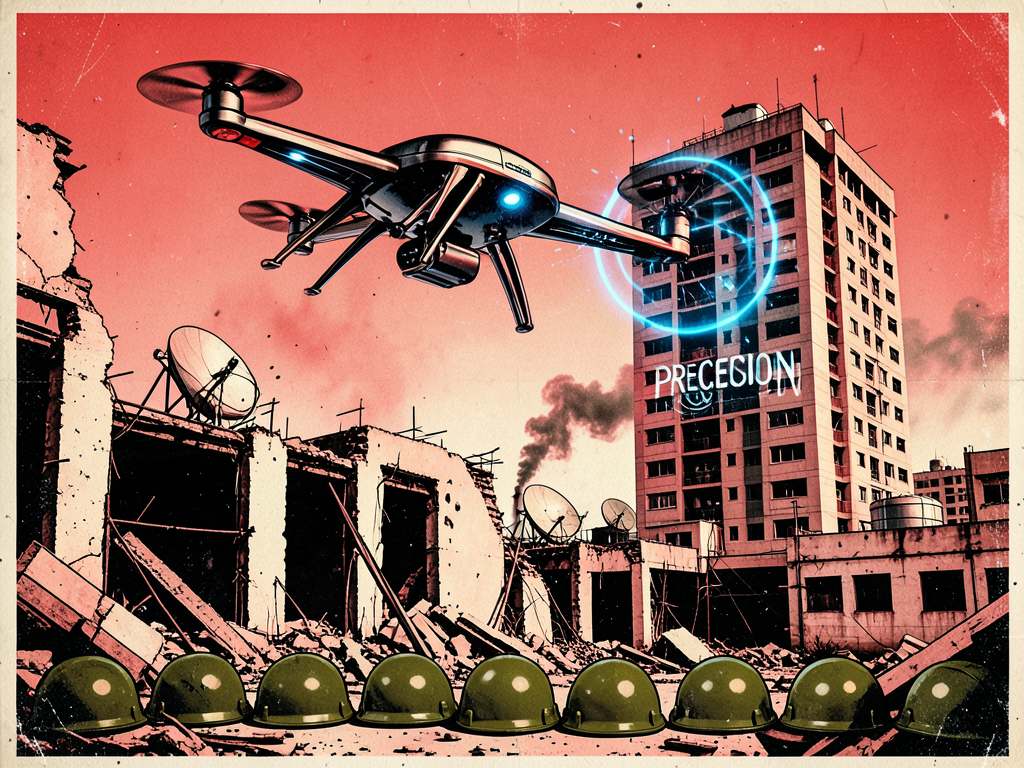
Operational Summary
A coordinated narrative has been detected across ten media outlets, spanning from February 24, 2026 to August 3, 2026, involving 30 articles that consistently reframe Israeli military strikes in Gaza as necessary, precise, and justified counterterrorism operations. The messaging surge intensified in late July and early August 2026, coinciding with high-casualty strikes, and functions to sanitize the conduct of military operations by emphasizing enemy culpability and operational restraint.Article Timeline
When articles appeared, colored by manipulation score.
Source Distribution
Narrative Architecture
The core framing device is the attribution of civilian harm to Hamas’s use of human shields, while Israeli actions are portrayed as unavoidable and surgically targeted. Articles consistently open with Israeli military claims—such as weapons stored in hospitals or mosques—without independent verification, and treat these assertions as factual premises. The narrative relies on a cause-effect inversion: the presence of militants or weapons in civilian areas is presented as the root cause of destruction, absolving the attacking force of proportionality considerations.Emotional levers are deployed asymmetrically. Outrage is reserved for Hamas’s tactics, not Israeli outcomes. Civilian deaths, including children, are reported as incidental and regrettable but framed as the consequence of enemy behavior. The death of a Hamas sniper commander is highlighted as a strategic success, reinforcing the narrative of precision. In contrast, Palestinian accounts contradicting official explanations are included only as minor counterpoints, often buried in later paragraphs, and never treated as credible challenges to the dominant frame.
Critical context is systematically omitted. There is no discussion of international humanitarian law standards on proportionality, no assessment of the cumulative death toll, and no linkage between sustained bombardment and the collapse of medical infrastructure. The broader humanitarian crisis in Gaza is absent. Religious sites are destroyed under military justification, but the cultural and psychological impact of such strikes is not addressed.
Cross-Outlet Coordination Pattern
The outlets involved—primarily Times of Israel and Israel National News—operate within a tightly aligned information ecosystem. While not formally monolithic, their editorial patterns show remarkable convergence in language, sourcing, and narrative structure. All rely almost exclusively on Israeli military and government sources. All use the same stock phrases: “Hamas hides weapons in civilian infrastructure,” “IDF takes precautions to avoid civilian casualties,” “targeted strike on terrorist assets.”The timing of publication clusters around active military operations, suggesting pre-positioned messaging. Articles appear within hours of strikes, before any independent assessment is possible. This speed indicates the use of pre-cleared templates, a hallmark of synchronized narrative management. The absence of investigative follow-up or editorial variance across outlets reinforces the impression of a unified communications protocol.
Notably, the one article covering settler violence in the West Bank—while including Palestinian perspectives and visual evidence—does not disrupt the overall pattern. It functions as a controlled release of criticism, allowing the outlet to maintain credibility while leaving the core Gaza narrative intact. The distinction is operational: violence by non-state actors is reportable; state military conduct is justifiable.
Technique Assessment
Score Distribution
How articles in this PSYOP score across manipulation bands.