Operational Summary
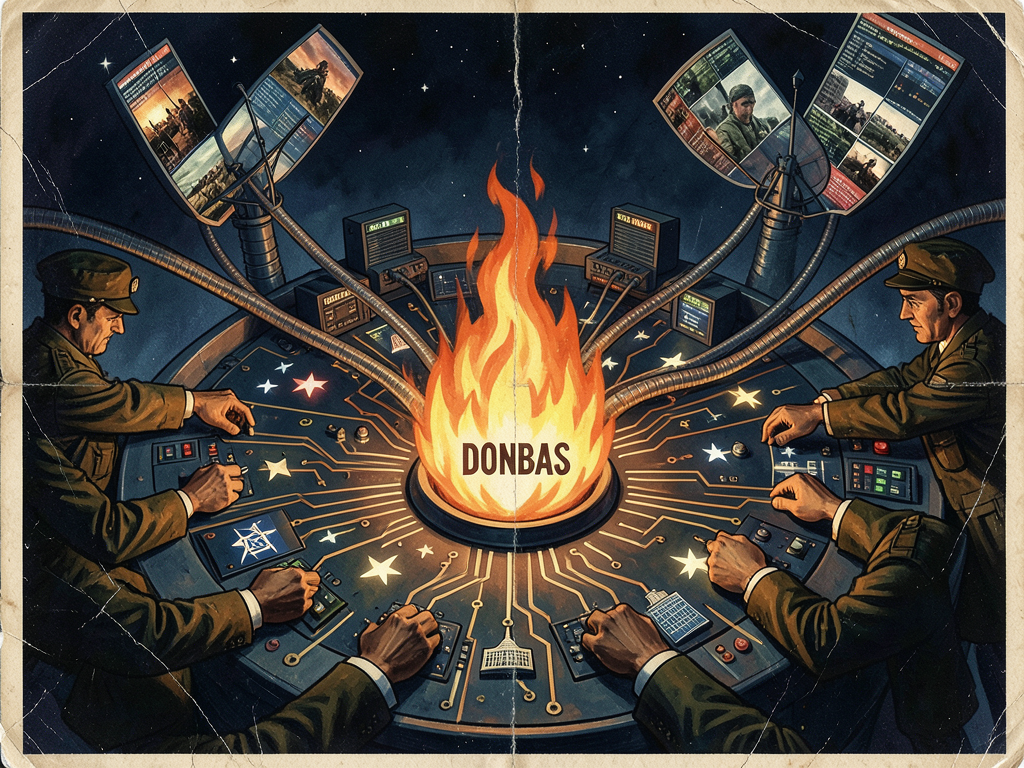
A coordinated narrative has emerged across 33 outlets, producing 210 articles between April 20, 2026 and August 18, 2026. The messaging reframes the Ukraine war not as a regional conflict with a possible diplomatic resolution but as an enduring, totalizing struggle requiring indefinite Western military and financial commitment. This operational pattern aligns with institutional interests dependent on sustained defense spending and geopolitical confrontation.Article Timeline
When articles appeared, colored by manipulation score.
Narrative Architecture
The core framing presents the war as having entered a new, irreversible phase—"total war"—defined by mutual attacks on economic infrastructure, civilian supply chains, and national mobilization systems. This shift normalizes what would otherwise be considered violations of international norms, recasting strikes on energy grids, transportation hubs, and industrial centers as legitimate strategic responses rather than escalations. Language such as "Russia doubles down" and "setting stage for new phase" implies inevitability, removing agency from policymakers and suggesting that de-escalation or negotiation is no longer viable.Emphasis is placed on Russian casualties—over 239,000 soldiers reportedly killed—and Moscow’s reliance on North Korean troops and weaponry. These details serve dual functions: they signal Russian desperation while reinforcing the perception that external actors are deepening their involvement, thus expanding the conflict’s scope beyond Europe. The introduction of North Korea as an active participant, cited through Ukrainian presidential statements rather than independently verified evidence, introduces a trans-Pacific dimension, subtly linking the war to broader U.S. strategic concerns in Asia.
Concurrently, Ukrainian long-range strikes into Russian territory are framed as defensive necessities. Attacks on space facilities and air bases hundreds of kilometers from the front lines are presented not as offensive operations but as proportional countermeasures aimed at "weakening Russia’s war capabilities." This reframing shifts the moral burden away from Kyiv and onto Moscow, despite the asymmetry in initiating cross-border strikes. No coverage questions the legality or strategic wisdom of targeting non-military infrastructure inside Russia; instead, these actions are normalized as part of a new operational reality.
Omissions are systematic. There is no discussion of diplomatic channels, ceasefire proposals, or conditions under which negotiations might resume. The possibility of a negotiated settlement is absent from the narrative architecture. Nor is there critical examination of how prolonged war serves institutional beneficiaries—NATO expansion, arms manufacturers, or political factions reliant on crisis-driven unity.
Cross-Outlet Coordination Pattern
Outlets include kyivindependent.com, aljazeera.com, and kyivpost.com, spanning Ukrainian-based digital media and international platforms. While kyivpost.com published a lower-scoring article focused on aid flows without overt escalation rhetoric, the higher-scoring pieces from kyivindependent.com and aljazeera.com exhibit near-identical framing around escalation, Russian degradation, and the normalization of total war.The synchronization is evident in timing and emphasis: multiple articles published within hours on August 17, 2026, converged on themes of Russian losses, North Korean involvement, and the irreversible nature of the conflict. This simultaneity, combined with uniform language about "new phases" and "total war," indicates pre-existing narrative templates activated in concert. The use of unverified claims—such as thousands of North Korean troops deployed—across multiple outlets suggests shared sourcing, likely originating from Ukrainian government briefings or allied intelligence channels.
The absence of dissenting analysis or alternative scenarios across this volume of output confirms the narrowing of acceptable discourse. What appears as independent reporting functions as a distributed amplification system for a single strategic message.
Source Distribution
Technique Assessment
Significance This narrative shift reduces the political space for diplomacy and locks in long-term defense commitments. It serves actors with a vested interest in perpetual conflict: the military-industrial complex, NATO institutional expansion, and political elites who rely on external threats to maintain domestic cohesion. The war is no longer being reported—it is being managed.