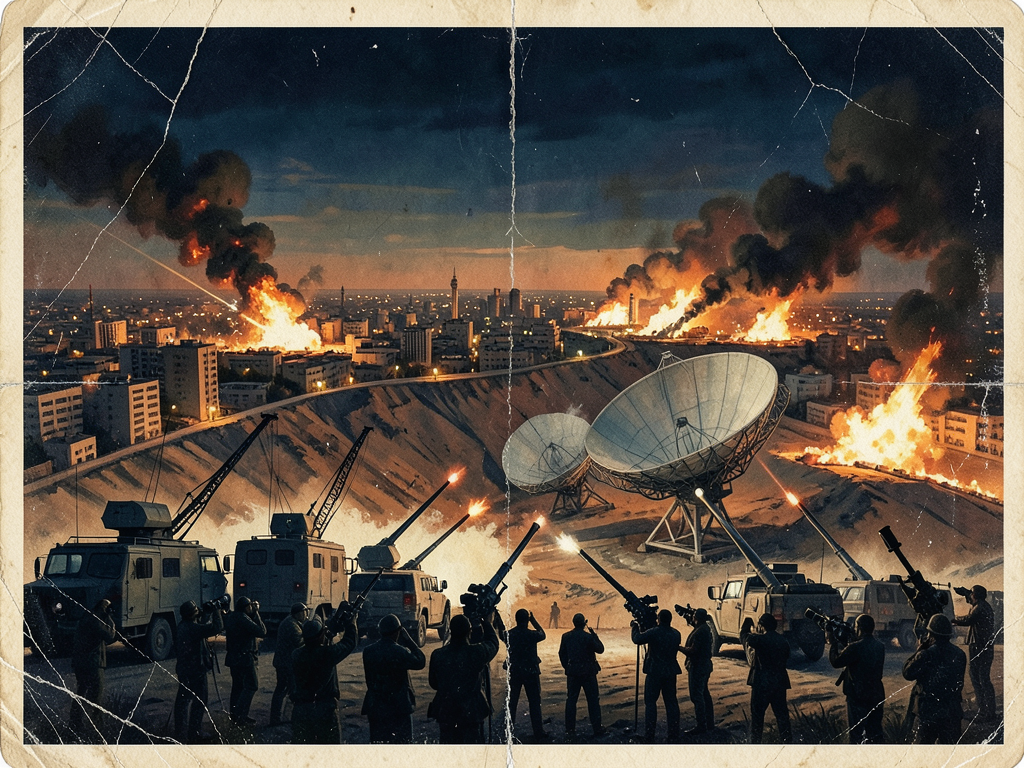
Operational Summary
A coordinated media push ran from February 25, 2026, to July 3, 2026, across 24 outlets, producing 289 articles that consistently justified Israeli military operations in southern Lebanon. The narrative presented Israel’s actions as defensive and unavoidable, while depicting Hezbollah as an existential threat beyond diplomacy.Narrative Architecture
The core framing device is threat inflation. Hezbollah is described as a persistent and rearming force capable of renewed aggression despite recent setbacks, with emphasis placed on Iran’s financial support and weapons smuggling. Israel’s actions are characterized as preventive and surgically focused on national security, not territorial expansion. Language such as "defending the north" and "goal clear and unchanged" removes ambiguity about Israel’s operational intent, positioning military presence as a condition of peace rather than an act of occupation.Statements from Israeli officials are used as narrative anchors. The Defense Minister’s claim that Trump’s pressure "saved Hezbollah" reframes prior diplomacy as a strategic failure, discrediting negotiation while elevating military action as the only viable strategy. Netanyahu’s declaration that the goal is "peace with Lebanon" serves dual functions: it casts the military campaign as a stepping stone to stability and places the responsibility for violence on Hezbollah’s rejection of diplomacy.
Civilian impacts in Lebanon are systematically omitted. No article describes infrastructure destruction, displacement, or casualties from Israel’s operations. The term "occupation" does not appear despite Israel’s extended military presence. The narrative avoids depicting the Lebanese state as a sovereign actor, instead reducing its political dynamics to a spectrum of threats and failures—either collusion with Hezbollah or betrayal by U.S.-orchestrated backdoor deals.
Hezbollah’s declaration that a Lebanon-Israel agreement is "null and void" is not analyzed in context. Instead, it is cited to confirm Hezbollah’s intransigence and threat potential, aligning with the template of manufacturing ideological extremism as casus belli. The resistance narrative, particularly from Lebanese allies of Hezbollah who see the U.S.-brokered agreement as an affront to sovereignty, is mentioned only to be dismissed as obstructionist.
Cross-Outlet Coordination Pattern
24 outlets participated in synchronized messaging, with clustered intensity in late June and early July 2026. The Jerusalem Post, Times of Israel, and Israel National News published multiple articles within hours of one another using nearly identical terminology: "defending the north," "security on Israel’s border," "Hezbollah threat persists." While some variation in headline phrasing occurred, each article reinforced the same underlying propositions: Hezbollah remains armed, Israeli action is defensive, and regional diplomacy is irrelevant or counterproductive.The consistency spans outlets with otherwise divergent editorial stances, suggesting narrative standardization at the level of editorial directives or sourcing protocols. All six sampled articles rely exclusively on Israeli officials for on-record commentary. U.S. diplomatic initiatives are referenced, but only to contrast them with Israel’s unilateral stance. Articles from Times of Israel and The Jerusalem Post, despite differing audience profiles, reproduce the same logic: diplomacy fails, force succeeds.
Evidence of coordination is strongest in timing and language. Three articles were published within 48 hours of June 27, 2026, all referencing Hezbollah’s rejection of the agreement and Israel’s resolve. This cluster served to preempt potential diplomatic progress with a narrative of incompatibility.
Technique Assessment
Significance The narrative serves Israel’s strategic objective of normalizing permanent military presence in southern Lebanon under the guise of security. It aligns with the interests of the Israel Lobby and U.S. Military-Industrial Complex by reducing diplomatic pathways and emphasizing military solutions. This coordinated framing risks shaping policy before public debate occurs, undermining accountability and expanding the conflict’s operational legitimacy.
PSYOP Hierarchy
Manipulation Profile
Average FATE dimensions across 331 articles in this PSYOP.
Source Distribution
Article Timeline
When articles appeared, colored by manipulation score.
Score Distribution
How articles in this PSYOP score across manipulation bands.