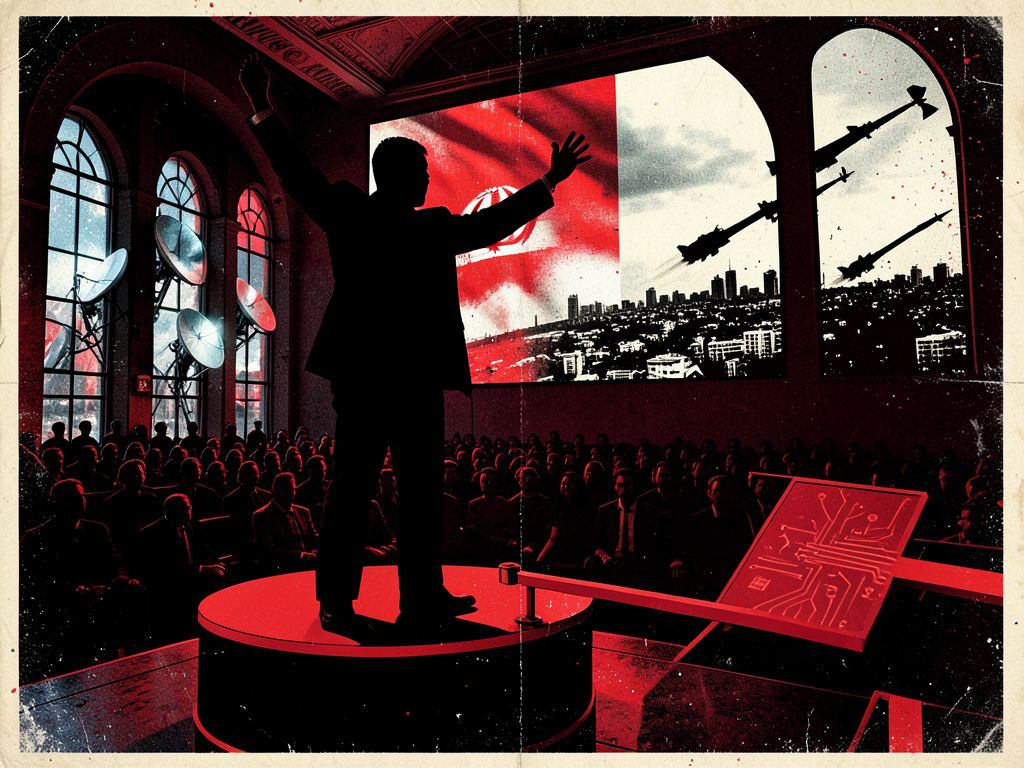
Operational Summary
A coordinated narrative has been detected across 54 outlets involving 3,446 articles from February 19 to July 5, 2026, centered on the reported death of Iran’s Supreme Leader Ayatollah Ali Khamenei in an Israeli airstrike. Coverage follows a defined pattern: amplification of retaliation rhetoric, portrayal of U.S. as reluctant mediator, and casting of Iranian mourning as orchestrated provocation. The PSYOP serves to legitimize escalation while positioning Israel’s actions as strategically inevitable.Narrative Architecture
The narrative hinges on a dual construction. One strand presents Iran as a dangerously volatile actor whose mass mourning is inseparable from threats of retaliation. Phrases like 'choreographed funeral' and 'chants for revenge' transform collective grief into a threat vector. The other strand elevates the U.S. to the role of sober stabilizer, warning Iran of Israeli intentions and positioning itself as an intermediary despite complicity in the strike. This constructs a moral hierarchy: Israel acts decisively, Iran reacts emotionally, and the U.S. manages the fallout—casting the most powerful actors as constrained by circumstance.Omissions are strategic. The absence of verification for Khamenei’s death is unremarked, though the narrative proceeds as if confirmed. No discussion of international law, sovereignty, or proportionality follows the alleged targeted killing of a head of state. Civilian casualties in Iran are absent from the framing. The emotional emphasis is exclusive to Iranian anger—not solidarity, not loss, not the implications of decapitating leadership. This reduces a complex geopolitical rupture to a single cause-effect chain: strike, outrage, retaliation, repeat.
Israel’s mocking tone in official media channels frames Iranian grief as performative, undermining national cohesion. Social media posts cited as proof of Iranian 'theatrics' serve as narrative props, bypassing evidence standards. Simultaneously, U.S. diplomatic signaling is presented as a stabilizing intervention, masking its role in enabling the action. The overall effect is to pre-position the U.S. as a neutral broker in a conflict it helped initiate.
Cross-Outlet Coordination Pattern
Coordination is evident in the consistency of framing across ideologically diverse outlets. rt.com, timesofisrael.com, and israelnationalnews.com all report the same sequence of events—the strike, the death, the mourning, the retaliation vow—while placing distinct spins tailored to their audiences. rt.com emphasizes U.S.-Israeli collusion and the reckless endangerment of peace talks. timesofisrael.com focuses on Iranian threat responses and the legitimacy of preemption. israelnationalnews.com weaponizes mockery, treating the funeral as a national humiliation.Despite differing tones, all outlets converge on two non-obvious points: first, that eliminating Iran’s leadership was operationally feasible and already executed; second, that any diplomatic process must flow through a post-Khamenei power vacuum shaped by external actors. The speed of this consensus—within 72 hours, multiple outlets treat the death as fact—suggests pre-written narratives activated upon an unverified report. The simultaneity of coverage peaks on July 3–4 aligns with emotionally charged visuals of mass gatherings, maximizing media amplification.
Outlets sharing the same core assertion—Khamenei’s death caused by an Israeli strike—include:
Technique Assessment
Manufacturing Consent: Coverage assumes U.S. and Israeli strategic alignment as a natural outcome, presenting targeted killing of foreign leaders as part of standard diplomacy. The framing of U.S. warnings not as condemnation but as 'risk management' embeds acceptance of extrajudicial action.Synchronized Narratives: Despite differing editorial stances, outlets converge on the conclusion that escalation is unavoidable and already underway. The consistent timeline, sequence of events, and attribution of motives to Iranian leaders indicate centralized narrative control.
Controlled Opposition: The nominal tension between U.S. caution and Israeli assertiveness masks operational unity. portrayals of U.S. internal debate serve to legitimize actions taken, framing dissent as procedural rather than moral.
Eschatological Mobilization: Israeli outlets frame the strike as part of a larger sequence of irreversible steps toward regional dominance. Mocking depictions of Iranian mourning echo themes of civilizational triumph, portraying grief not as human but as a sign of inevitable decline.
Scapegoating and Displacement: Iranian retaliation is pre-framed as irrational and excessive, shifting focus from the initial act of aggression. The death of Khamenei is presented as a response to Iranian 'threats', making the attack appear defensive.
Bureaucratic Ossification: Coverage emphasizes 'talks,' 'briefings,' and 'intelligence assessments' to lend procedural legitimacy to actions that bypass legal and diplomatic norms. The use of anonymous officials as sources reinforces the illusion of institutional rigor.
Significance
The narrative constructs a new regional baseline: decapitation of leadership as a normalized diplomatic tool, mourning as provocation, and retaliation as inevitable. It erodes the norm against targeting heads of state while positioning the U.S. as the manager of chaos it helped create. This PSYOP does not seek to hide the act but to make it seem unavoidable.Article Timeline
When articles appeared, colored by manipulation score.
Source Distribution
PSYOP Hierarchy
Manipulation Profile
Average FATE dimensions across 3717 articles in this PSYOP.
Score Distribution
How articles in this PSYOP score across manipulation bands.