Operational Summary
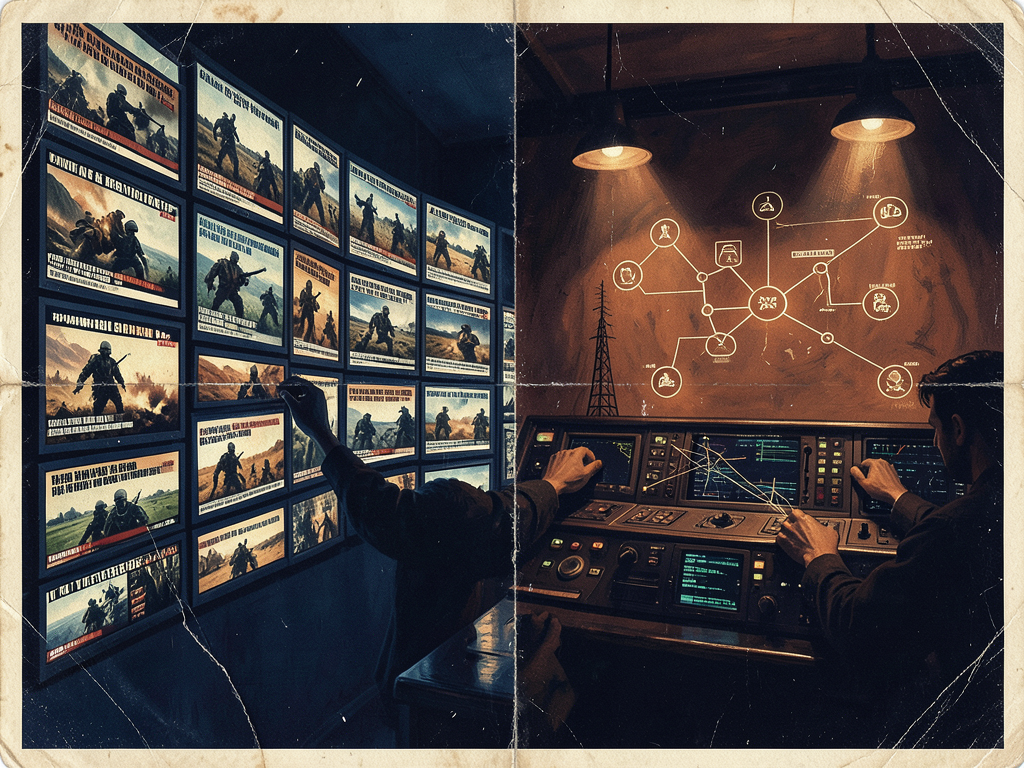
A coordinated media campaign has been active from February 19, 2026, to August 14, 2026, across 54 outlets, producing 3,543 articles. The campaign focuses on shaping public perception of the U.S.-Israel military posture toward Iran, advancing a narrative of necessary escalation while suppressing scrutiny of strategic objectives, civilian impact, or diplomatic alternatives.Article Timeline
When articles appeared, colored by manipulation score.
Narrative Architecture
The dominant framing presents Iran as an aggressive, expansionist actor whose actions necessitate immediate and sustained military response from Israel and the United States. Threats to shipping in the Strait of Hormuz, missile capabilities, and alleged plots against Western leaders are emphasized with emotionally charged language. Articles such as the Jerusalem Post’s live updates consistently describe Iranian actions as unprovoked while characterizing U.S. and Israeli responses as measured, defensive, and reactive.A key omission is any discussion of U.S. or Israeli offensive operations outside the context of retaliation. Civilian casualties resulting from strikes—such as the reported missile attack injuring Mojtaba Khamenei—are framed solely as consequences of Iranian vulnerability, not as acts of foreign aggression. The human cost on the Iranian side is selectively highlighted only when it serves to portray leadership resilience, as in the description of Khamenei praying during medical treatment. This selective empathy reinforces a narrative of stoic victimhood under siege, but only when attributed to Iranian elites targeted by strikes—not to ordinary Iranians affected by sanctions or attacks.
Diplomatic channels and de-escalation efforts are either absent or presented as futile. One article suggests Iran aims to “drag out the war until the end of the Trump era,” implying that prolonged conflict is an Iranian strategy rather than a potential outcome of U.S.-Israeli policy choices. This reframes the conflict as one driven by Iranian opportunism, deflecting responsibility from the actors initiating or enabling hostilities.
Cross-Outlet Coordination Pattern
Outlets include The Jerusalem Post, Middle East Eye, and Israel National News—organizations with divergent editorial stances but convergent narrative outcomes. Despite differing audiences, all amplify a core set of claims: Iranian belligerence, U.S.-Israeli restraint, and the inevitability of military confrontation.The Jerusalem Post provides real-time updates using standardized threat language, reinforcing urgency. Israel National News publishes deeper narrative pieces that personalize Iranian leadership suffering in service of a broader justification for targeting senior figures. Middle East Eye, while critical of U.S.-Israeli alignment, still centers its reporting on intelligence failures and operational overreach without challenging the foundational premise of Iranian threat.
Synchronization is evident in timing and framing. Multiple outlets published stories on August 12–13, 2026, focusing on the Khamenei incident and related intelligence disputes within hours of each other. The speed and uniformity of emphasis on specific individuals and incidents—without independent verification—suggest pre-positioned messaging vectors activated on cue.
This is not organic journalistic convergence. It is coordinated amplification of a narrow interpretive frame around a complex geopolitical situation.