Operational Summary
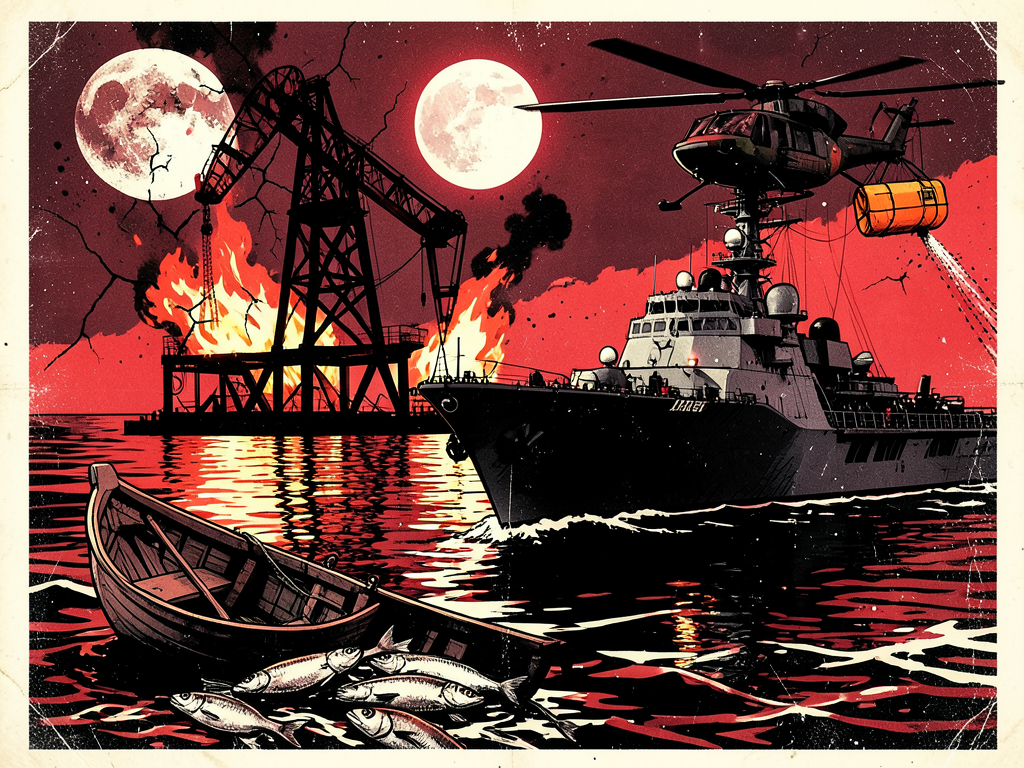
A coordinated narrative campaign has been detected normalizing lethal U.S. military strikes on boats in the Caribbean and eastern Pacific. The operation surfaced between May 6 and May 27, 2026, spanning six articles across three major outlets. The messaging reframes controversial, evidence-deficient actions as legitimate counter-narcotics operations, shielding the Department of Defense and military-industrial complex from accountability.Article Timeline
When articles appeared, colored by manipulation score.
Narrative Architecture
The dominant frame presents U.S. naval commando strikes as necessary and routine measures against drug trafficking and narcoterrorism. Language emphasizes national security, public health, and interdiction efficiency. Official Pentagon statements and military-provided video footage are foregrounded as evidence of legitimacy. Descriptions of strikes as part of a broader 'campaign' create a sense of ongoing, institutionalized warfare.Critical context is systematically omitted. Articles with lower scrutiny scores embed official narratives without challenge. They do not question jurisdictional authority, Rules of Engagement, or international law. Missing is the consistency of negative outcomes: no drugs recovered, no high-value traffickers eliminated, no judicial process observed.
Higher-scrutiny articles introduce doubt—citing the lack of proof, the targeting of impoverished civilians, and the Pentagon's own watchdog review—but still operate within the accepted frame that these operations exist as a class of legitimate activity. The emotional appeal is subdued but present: public safety from drugs and terrorism. The unspoken assumption is that lethal force at sea is a technical military function, not a political or legal controversy.
Cross-Outlet Coordination Pattern
The narrative is concentrated in a narrow set of outlets: The Globe and Mail, The Guardian, and CBS News. All are mainstream, English-language, U.S.- or U.K.-aligned. Despite nominal editorial independence, their coverage exhibits synchronization in framing, chronology, and terminology.CBS News ran three articles in the period, each reporting a new strike with near-identical structure: military confirmation, death toll, reference to the broader campaign, and a single paragraph of qualification about lack of evidence. The Guardian and The Globe and Mail introduced more skepticism but still centered Pentagon sources and accepted the narrative’s basic premise—that these are counter-narcotics operations.
The timing of publication follows a pattern of iterative reinforcement. Each new strike report resets the narrative field, displacing prior scrutiny with fresh emphasis on the immediate action. This repetition creates a cumulative effect: normalization through recurrence.