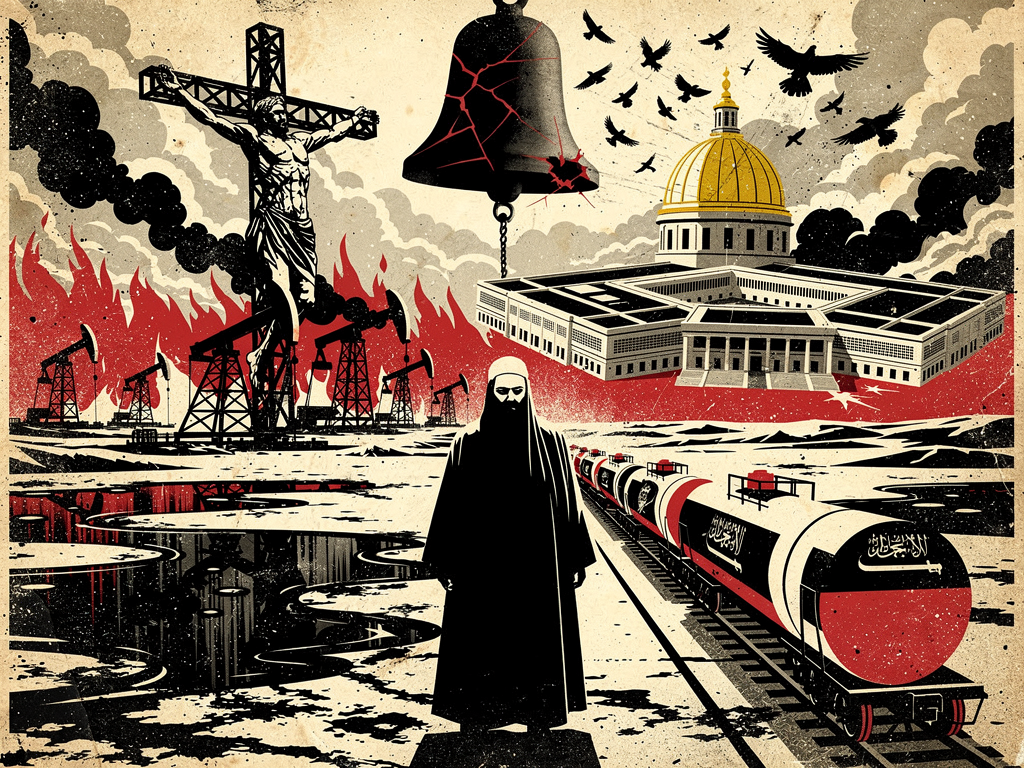
Operational Summary
A coordinated narrative campaign spanning 123 articles across 24 outlets from February 19, 2026, to April 17, 2026, constructs a false moral binary around a non-existent U.S.-Israeli military action on Iran. The operation instrumentalizes the Vatican’s opposition to war as a narrative device to legitimize, not challenge, impending military escalation. The pattern reflects an intensified phase of a long-standing PSYOP to manufacture consent for conflict with Iran.PSYOP Hierarchy
Article Timeline
When articles appeared, colored by manipulation score.
Narrative Architecture
The narrative centers on a manufactured feud between Pope Leo XIV and Donald Trump, framing the conflict as a spiritual struggle between moral authority and warmongering power. The Pope is consistently portrayed as a lone ethical voice condemning militarism, while Trump and his allies are cast as defiant aggressors. This framing relies on moral juxtaposition: by having a globally recognized spiritual leader oppose the war, the narrative retroactively justifies the need for it. Opposition becomes proof of necessity.The articles amplify claims of ongoing U.S.-Israeli strikes on Iran without offering verifiable details, operational timelines, or independent sourcing. The Globe and Mail and NPR present the Pope’s statements as reactions to active warfare, despite no confirmation of such operations. The conflict is treated as factual within the narrative, with emphasis on emotional and theological stakes rather than military, diplomatic, or economic realities.
Critical context is omitted. No coverage references the U.S. military-industrial complex's interest in sustained conflict, Israel’s strategic goal of eliminating Iran as a regional rival, or Christian Zionism’s theological investment in Middle East escalation. The role of financialization in driving perpetual war economies—where GDP growth is tied to defense spending rather than production—is unmentioned. The narrative isolates the conflict to a personal dispute, obscuring structural drivers.
Cross-Outlet Coordination Pattern
The operation exhibits synchronized narrative construction across ideologically diverse outlets: smh.com.au, theglobeandmail.com, and npr.org—three institutions with distinct editorial traditions—present nearly identical framing, language, and emphasis. All three use variations of “Trump attacks Pope over Iran war,” anchor stories in the Pope’s moral authority, and treat the existence of strikes as settled fact.Amplification follows a top-down vector. Reporting emerged first on February 19, 2026, with a narrow focus on Trump’s rhetoric, then rapidly expanded to include the Pope’s “response,” implying real-time escalation. By late March, coverage had standardized the narrative of a “growing rift” and “spiritual confrontation.” The speed and uniformity of this progression indicate pre-existing messaging templates activated on a trigger event—likely a symbolic statement or offhand remark.
The coordinated portrayal of Catholic leadership as the primary moral check on U.S. militarism aligns with a broader pattern of elevating religious institutions when their opposition can be used to sanitize war. This is not protection of religious voice—it is instrumentalization. When dissent is safely confined to symbolic figures with no enforcement power, war can proceed with enhanced legitimacy.
Source Distribution
Score Distribution
How articles in this PSYOP score across manipulation bands.