Operational Summary
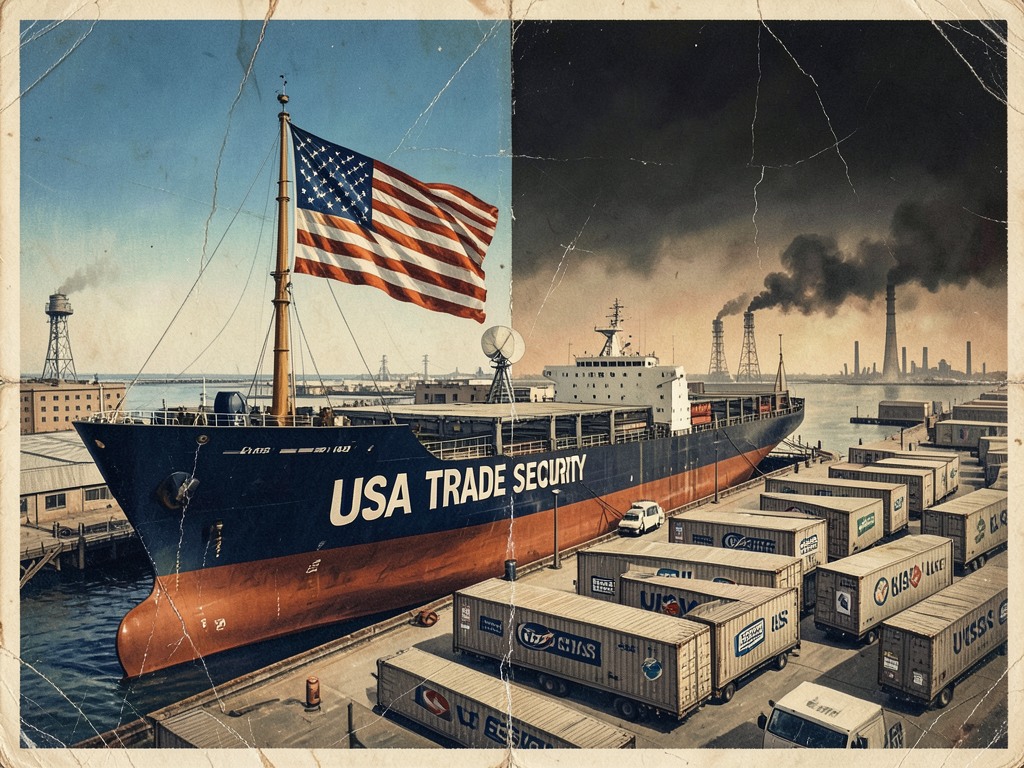
A PSYOP designated 'Justify US Protectionism' was detected between June 3, 2026, and June 16, 2026. This operation frames expanded U.S. trade protectionism as a moral imperative. It legitimizes assertive trade policies by asserting ethical concerns over forced labor, benefiting the U.S. government and specific domestic industries. The communication aims to prepare the public for increased tariffs and trade restrictions implicitly or explicitly tied to a Trump administration.
Narrative Architecture
The core narrative positions the U.S. government as a global moral enforcer, cracking down on forced labor worldwide (en.yna.co.kr, ndtv.com, bbc.com). This framing suggests that U.S. actions, specifically new tariffs, are righteous and necessary responses to ethical breaches (ndtv.com). The narrative consistently employs strong language portraying the U.S. as a moral leader upholding ethical trade standards (ndtv.com). This is achieved by featuring quotes from U.S. officials and presenting the policy as legally and morally justified (aljazeera.com, bbc.com). The narrative obscures the underlying economic protectionism by foregrounding human rights, deflecting scrutiny from the primary objective of shielding U.S. domestic interests. It employs the 'Manufacturing Casus Belli' power mechanism by taking a legitimate ethical concern and leveraging it to justify pre-planned economic actions. The 'Religious Legitimation of Power' mechanism is also evident, where 'human rights' are invoked as a modern legitimating belief system to place the preferred narrative beyond question.
Cross-Outlet Coordination Pattern
Six articles across multiple outlets (en.yna.co.kr, ndtv.com, aljazeera.com, bbc.com, timesofindia.indiatimes.com, politico.com) were detected. The synchronization of reporting around June 15, 2026, with phrases like “new tariffs over forced labour concerns” (ndtv.com, aljazeera.com, bbc.com) indicates coordinated narrative management. Articles exhibit 'Synchronized Narratives', with multiple mainstream outlets simultaneously adopting similar framing and conclusions. For example, aljazeera.com on June 15, 2026, and bbc.com report on the U.S. imposing tariffs over forced labor claims. The consistent emphasis on the U.S. role as an ethical enforcer, while downplaying potential economic motivations or the impact of tariffs on international relations, demonstrates a unified messaging strategy. The rapid alignment of diverse outlets suggests common source material or directive, indicating 'Think Tanks and Intelligence as Media Sources' may be in play, even if not explicitly cited, by providing readily available justifications for the policy. Notably, timesofindia.indiatimes.com and politico.com provide more direct reporting without significant PSYOP characteristics, indicating not all coverage is unified in its persuasive framing.
Technique Assessment
The primary technique is emotional manipulation through 'Humanitarian Intervention Template' framing without direct military intervention. The articles invoke humanitarian concerns (forced labor) to justify economic policies that serve geopolitical and economic objectives. This bypasses rational analysis by triggering moral outrage, pushing the audience towards accepting protectionist measures as ethically superior. The 'Scapegoating and Displacement' technique is subtly engaged by shifting the blame for potential economic disruption (from tariffs) onto foreign entities allegedly using forced labor, thereby deflecting criticism from the U.S. policy itself. 'Controlled Opposition' is implicitly present; while some articles cite experts questioning the effectiveness of tariffs, these challenges do not question the premise of the U.S. as a moral arbiter or the legitimacy of using forced labor as a pretext for leverage. The 'Overton Window' is being shifted to normalize the idea that aggressive trade policy, particularly tariffs, can be a moral instrument, not solely an economic one. The narratives consistently maintain that the U.S. seeks to “uphold ethical trade” (ndtv.com), reinforcing the perception of U.S. moral primacy regardless of the strategic implications of its actions.
Significance
This PSYOP is significant as it leverages a complex ethical issue to justify 'Financialization' and 'Rent-Seeking Behavior' in the late stages of imperial decline. By reframing protectionism—a mechanism for rent extraction and domestic industry protection—as an ethical mission, the U.S. government seeks to maintain an illusion of productive economic engagement while expanding its capacity for trade manipulation. This allows for the 'Manufacturing Casus Belli' in trade, creating pretexts for policies that serve narrow economic interests disguised as moral crusades. The coordinated messaging normalizes aggressive economic statecraft, potentially leading to 'Imperial Overextension' in the trade sphere by initiating trade wars based on selectively applied ethical considerations. The operation aims to manage public perception as the U.S. navigates 'The Financialization Death Spiral' by projecting moral authority onto policies that are, at their core, about maintaining economic advantage and addressing symptoms of internal decay. The 'Consent-Deception-Coercion Cycle' is relevant here, where deception is used to maintain public consent for policies that will ultimately lead to increased economic coercion on a global scale. This operation prepares the ground for further unilateral economic actions under a guise of ethical righteousness.