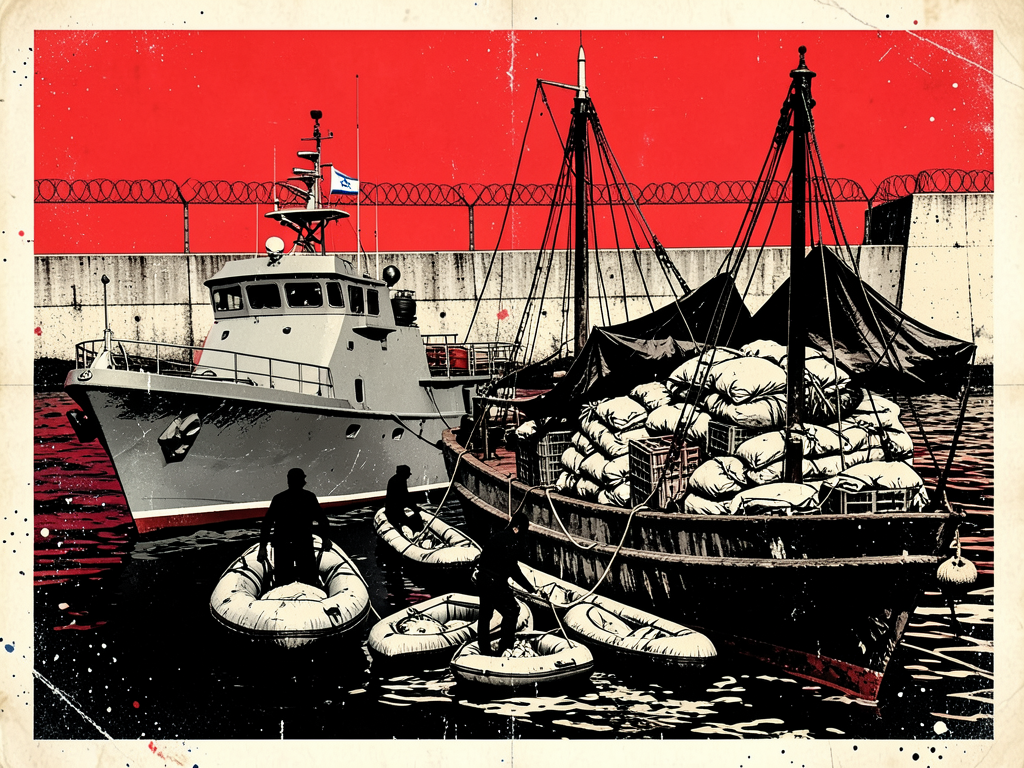
Operational Summary
A synchronized narrative emerged between April 30 and May 3, 2026, across 13 articles in 8 international outlets, aimed at reframing Israel’s interception of civilian aid vessels to Gaza as a legitimate security operation. The operational target is international public opinion, with messaging designed to recharacterize lawful humanitarian missions as provocative acts unworthy of diplomatic protection.Article Timeline
When articles appeared, colored by manipulation score.
Narrative Architecture
The narrative centers on a dual framing device: the flotilla is portrayed not as a humanitarian endeavor but as a political provocation, while Israel’s use of force is depicted as measured and legally justified. Key outlets such as ynetnews.com detail IDF statements describing the seizure of over 20 boats and 170 detainees, presenting the operation as calm and professional. Visual evidence released by Israel is cited to reinforce legitimacy, while reported injuries and claims of misconduct are backgrounded.A critical omission in compliant outlets is the location of intercepts in international waters, more than 500 nautical miles from Israel, as noted in theglobeandmail.com. This contradicts the feasibility of an imminent security threat. Instead, narratives emphasize Israeli sovereignty concerns, maritime law violations, and purported discovery of contraceptives and narcotics on one vessel—details selectively offered to imply illegitimacy.
Humanitarian intent is reframed as political theater. Terms like 'publicity stunt' are attributed to Israeli officials without editorial challenge. The activist profile is narrowed to 'radical' or 'anti-Israel' rather than multi-national civilians exercising maritime rights. No outlet highlights parallel legal actions or adherence to humanitarian convoy precedents, such as UNRWA-approved shipments.
Emotional levers are inverted: outrage is not directed at violence against unarmed civilians but at the perceived breach of Israeli maritime control. Language like 'piracy'—used by activists to describe Israeli detention—is presented as hyperbolic rather than a legal claim. The injured are not framed as victims but as participants in an illegal act.
Cross-Outlet Coordination Pattern
The outlets involved—rnz.co.nz, bbc.com, smh.com.au, ynetnews.com, theglobeandmail.com—share a core narrative structure despite geographical dispersion. All report the number of detainees, the release of most activists in Greece, and Israel’s security rationale. The framing of Israel’s actions as lawful is consistent, even where facts suggest otherwise: interception in international waters, destruction of vessels, and civilian injuries.British, Australian, Canadian, and New Zealand coverage aligns with language patterns seen in Israeli state media. The BBC and Sydney Morning Herald use nearly identical phrasing—'Israel justifies the action over security concerns'—suggesting common source output. Only theglobeandmail.com challenges this narrative arc, reporting jamming of communications, destruction of boats, and activists left adrift.
Ynet News, an Israeli-owned outlet, serves as the primary amplification vector, introducing 'contraceptives and narcotics' as proof of illegitimacy. This detail is absent in other reports, indicating a tiered dissemination model: flagship outlets seed selective discreditation points which are then omitted or echoed based on target audience tolerance.