Operational Summary
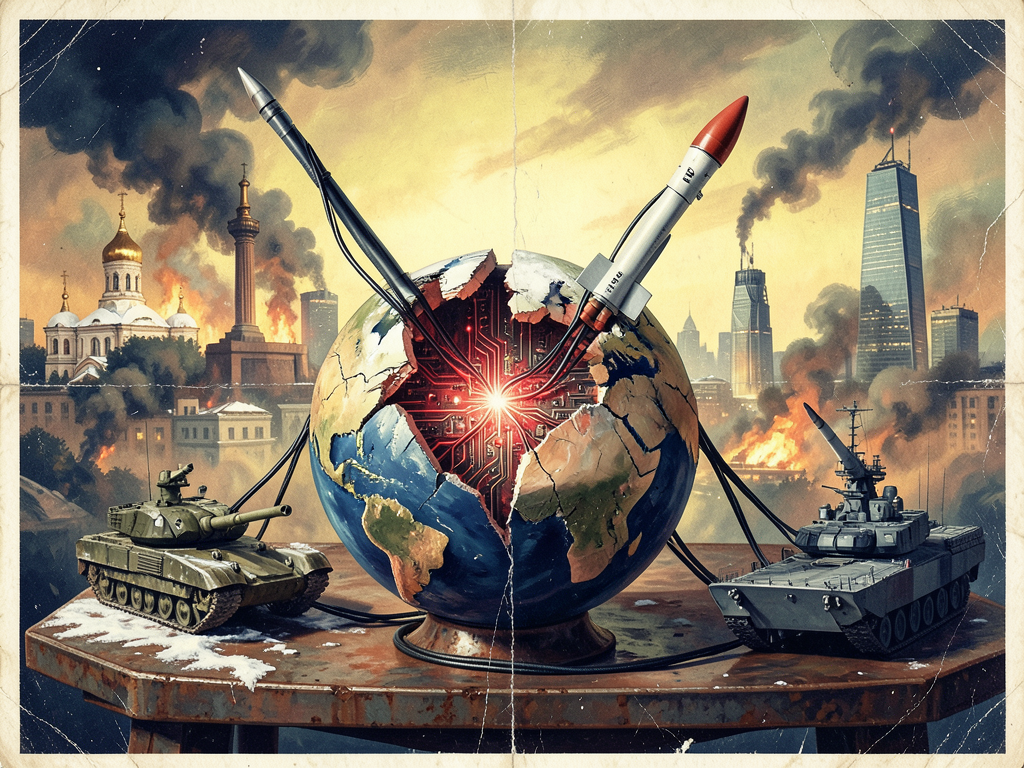
A coordinated narrative pattern has been detected between March 12, 2026 and May 7, 2026, portraying deepening military and strategic ties between Russia, North Korea, and China as evidence of a unified threat axis. This messaging, carried across seven articles in three outlets, amplifies isolated developments to construct a perception of coordinated alignment among adversarial powers. The narrative serves to justify increased defense spending and a more aggressive posture by the United States and its allies.Narrative Architecture
The narrative centers on physical infrastructure and diplomatic exchanges, selectively amplifying their strategic implications. The BBC article on the new bridge between Russia and North Korea frames the project as a potential enabler of war support, citing experts and official statements that emphasize its military utility. No meaningful analysis of logistical constraints, sanction enforcement, or bilateral friction is included. The bridge is presented not as a logistical project but as a symbolic and operational node in an emerging tripartite bloc.Simultaneously, four articles from Yonhap News Agency report on meetings between Kim Jong-un and Chinese Foreign Minister Wang Yi. Each piece highlights statements about deepening ties, mutual support, and ideological alignment. The consistent framing is one of cohesion and strategic convergence. Omitted are any references to historical North Korean ambivalence toward China, Beijing’s enforcement of UN sanctions, or contradictions in Pyongyang’s foreign policy. The result is a narrative of seamless, growing unity.
The news of North Korea’s ambassador briefing China’s ruling party on party congress outcomes completes the picture: a closed-loop system of political trust. The articles avoid probing the functional limits of this relationship or China’s strategic hedging. The cumulative effect is a sanitized, deterministic portrayal of alliance formation, designed to evoke threat.
An emotional lever common to all articles is the inevitability of threat convergence. Readers are led to infer a structural shift in global power dynamics—not from evidence of joint operations or command integration, but from the accumulation of bilateral gestures. The narrative bypasses the complexity of inter-state calculation in favor of a monolithic, adversarial bloc.
Cross-Outlet Coordination Pattern
BBC and Yonhap News Agency form the core of this coordinated pattern. BBC’s coverage stands out for its interpretive depth, presenting satellite imagery and expert commentary that elevate a construction project into a geopolitical signal. Yonhap, while publishing multiple articles that vary only slightly in wording, provides mechanical repetition of official statements from Pyongyang and Beijing, lending an illusion of sustained, independent diplomatic momentum.The divergence in sourcing strategy is notable: BBC relies on imagery and anonymous experts, while Yonhap quotes state media directly. Yet the convergence in framing—deepening ties, prioritization of strategic alignment, resistance to U.S. pressure—suggests a shared narrative vector. The timing of the articles, clustered between March and May, indicates synchronized dissemination rather than organic news flow.
This is not a spontaneous media reaction to an event. The narrative lacks investigative follow-up, critical voices, or counter-perspective. It unfolds as a pre-prepared storyline activated by minor diplomatic movements. Independent outlets and alternative sources are absent from the propagation chain.