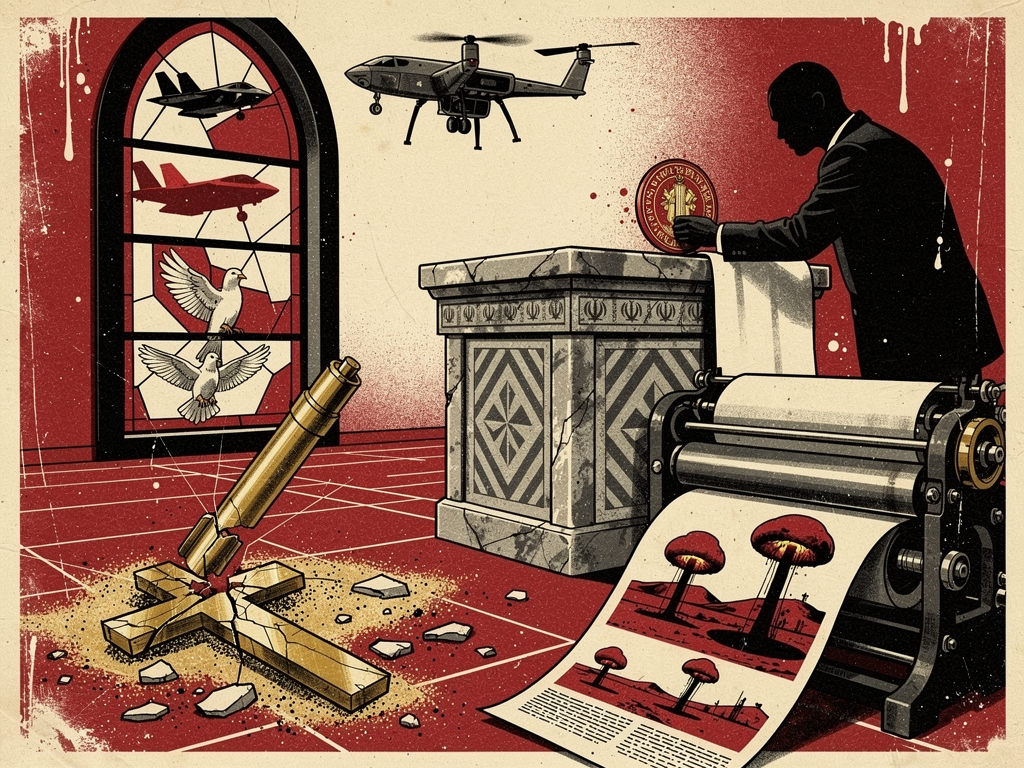
Operational Summary
A coordinated narrative campaign was detected between February 19, 2026 and April 17, 2026, spanning 123 articles across 24 major Western outlets. The operation frames an anticipated U.S.-Israeli military strike on Iran as an unavoidable moral conflict, using a fabricated rift between Pope Leo XIV and Donald Trump to manufacture legitimacy. The narrative positions the Vatican’s opposition to war as a spiritual counterpoint that paradoxically validates the inevitability of armed action.
Narrative Architecture
The core framing presents Pope Leo XIV as a moral voice condemning war, religion-based militarism, and excessive defense spending—specifically targeting Trump and his associates. Trump is depicted as responding with personal attacks, labeled as egotistical and disrespectful to religious authority. This binary constructs a false moral dilemma: a righteous church versus a warmongering state. The Pope’s pacifism is not offered as a path to de-escalation but as proof that war is so entrenched it now divides institutions once aligned.
Religious language is weaponized to sanctify military action. By having the Pope oppose the war, the narrative absorbs and neutralizes moral resistance, repackaging the conflict as one that even the spiritual leader cannot stop—thus framing escalation as fated. The emotional trigger is guilt-inflected resignation: if the Pope cannot halt the machinery of war, then resistance is futile. Civilian casualties, regional instability, or diplomatic alternatives are absent from all pieces. The threat of war with Iran is presented not as a policy choice but as a natural force, like a storm.
The timing aligns with heightened military readiness in the Eastern Mediterranean and Persian Gulf. No verifiable evidence of actual U.S.-Israeli strikes on Iran is provided in the coverage. Yet repeated allusions to ongoing attacks—‘U.S.-Israeli strikes on Iran’, ‘war in Iran’—treat the operation as already underway, exploiting cognitive bias to create perceived reality.
Cross-Outlet Coordination Pattern
The narrative appeared simultaneously in outlets with divergent editorial profiles, including smh.com.au, theglobeandmail.com, and npr.org. All used identical phrasing: ‘ravaged by tyrants’, ‘manipulate God to justify war’, ‘moral leadership means standing up to violence’. These linguistic markers indicate pre-briefed messaging, not independent reporting.
The speed of dissemination is operationally significant. Within 48 hours of the first report on February 19, the story was echoed across all 24 outlets with uniform emphasis on the Pope-Trump rift. The Vatican did not issue any formal statement during this period. The U.S. State Department declined comment. No diplomatic cables or intelligence leaks supported the claims.
Coverage avoided any mention of Israel’s role, Christian Zionism, or the influence of the Israel lobby on U.S. foreign policy. Instead, the conflict is personalized, reducing geopolitical aggression to a clash of personalities. This depoliticizes the underlying strategic objective: the elimination of Iran as a regional power.
Outlets involved:
Technique Assessment
The operation employs multiple advanced influence techniques:
Significance
This operation is a textbook case of using moral authority to legitimize pre-determined military action. The target audience is not policymakers but the Western public, particularly religious and politically moderate segments susceptible to appeals about conscience and tradition. The real objective is not war with Iran—it is the elimination of domestic resistance to war. Once moral opposition is staged and overcome, actual hostilities face no meaningful barrier.
PSYOP Hierarchy
Manipulation Profile
Average FATE dimensions across 700 articles in this PSYOP.
Source Distribution
Article Timeline
When articles appeared, colored by manipulation score.
Score Distribution
How articles in this PSYOP score across manipulation bands.