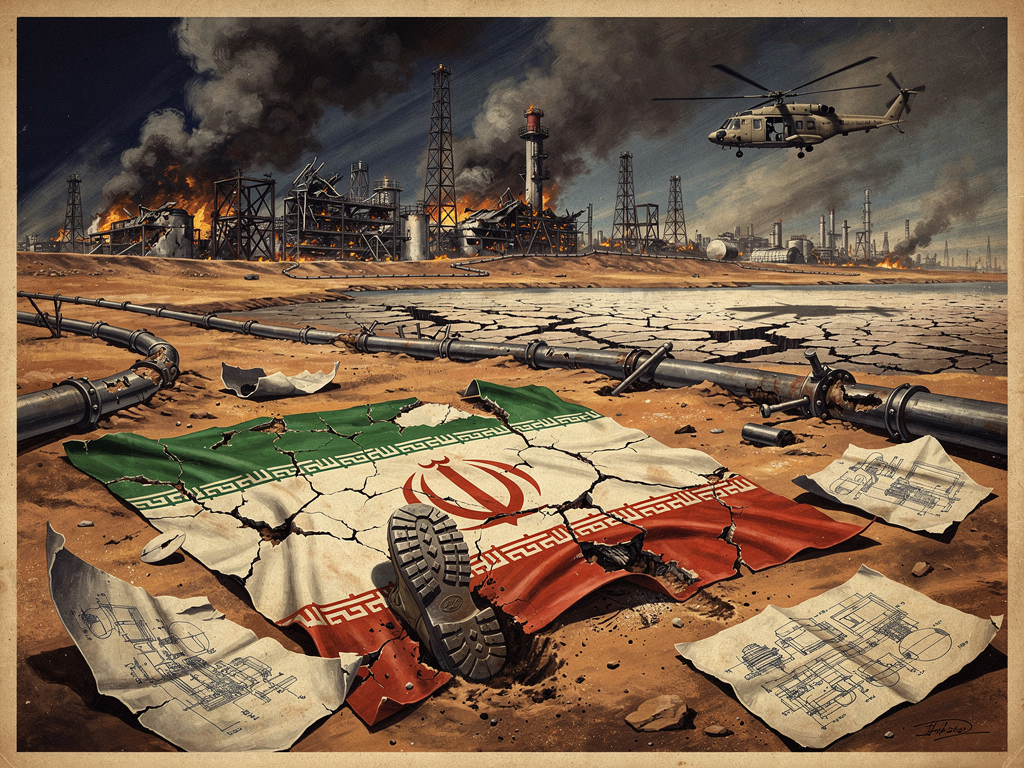
Operational Summary
A coordinated narrative emerged between April 14, 2026, and April 18, 2026, across 24 articles in 13 outlets, asserting that Iran was capitulating to U.S. demands under pressure from the Trump administration. No evidence of formal negotiations, agreements, or diplomatic breakthroughs was substantiated. The operation advanced the interests of the U.S. military-industrial complex, Israeli strategic objectives, and Trump’s political persona by constructing an illusion of coercive success.
PSYOP Hierarchy
Narrative Architecture
The narrative constructs Iran as reactive, cornered, and nearing capitulation, despite absent proof of material policy shifts. U.S. military escalation—blockades, threats to mine the Strait of Hormuz, bombing campaigns—is framed as necessary, restrained, and diplomatically principled. Iranian responses are described as volatile and desperate, reinforcing the image of a state on the brink.
Multiple articles highlight Iranian actions—closing the Strait of Hormuz, firing on vessels—as escalatory, while omitting verification of the U.S. blockade that allegedly prompted the response. The Times of India framing suggests Iran is proposing new transit fees, implicitly casting it as a predatory actor, though international law disallows such measures in strategic straits.
The emotional core of the narrative is urgency. The Middle East Eye article quotes Trump threatening to resume bombings if no deal is reached by Wednesday, presenting war as an automatic outcome rather than a policy choice. This removes agency from leadership and obscures decision-making, conditioning audiences to accept military action as inevitable. Iran’s strategic patience, a documented component of its long-term doctrine, is erased in favor of a script depicting imminent collapse.
Cross-Outlet Coordination Pattern
The narrative spread across outlets with divergent editorial leanings, suggesting coordinated messaging rather than organic consensus. SMH, Al Jazeera, and The Times of India—typically skeptical of U.S. unilateralism—adopted language unusually favorable to the Trump administration’s posture. Middle East Eye, which often critiques Western interventions, ran nearly identical framing in two separate articles, amplifying the capitulation thesis.
All coverage converged on the same timeline: Iran under duress, reviewing U.S. proposals, with failure leading to war. The repetition of ‘new U.S. proposals’ without detail, and the use of the Pakistani intermediary as a plot device, suggests a single source narrative. SMH, Al Jazeera, and Times of India all echoed this point without citing documentation or named officials.
The simultaneous use of emotionally charged terms—‘ceasefire may end’, ‘can’t blackmail us’, ‘reviews new proposals’—across independent platforms indicates narrative laundering. The lack of investigative follow-up or alternate interpretations confirms the presence of a pre-prepared media template.
Outlets involved:
Source Distribution
Article Timeline
When articles appeared, colored by manipulation score.
Technique Assessment
The primary technique is Manufacturing Casus Belli (1.5), constructing a false pretext for escalation by implying Iran is on the verge of surrender, thus justifying further pressure. The absence of verified negotiations is concealed through suggestive language, creating a perception of diplomatic momentum.
Controlled Opposition (1.6) is absent—the narrative offers no critical counterpoint, even in traditionally independent outlets. Instead, a false debate is manufactured between ‘engagement’ and ‘firmness’, both of which presuppose U.S. dominance.
The operation employs Synchronized Narratives (3.2). Identical phrasing about ‘reviewing new U.S. proposals’ and the ‘Wednesday deadline’ appeared within hours of each other across outlets, indicating centralized distribution.
Emotional Manipulation (3.6) is central: the threat of immediate war and the specter of naval blockade trigger fear-based compliance. The mention of attacks on French peacekeepers introduces external chaos to justify continued aggression while redirecting attention from U.S. actions.
The narrative further exemplifies Revelation of Method (1.17). By openly referencing backchannel ‘proposals’ and deadlines, it mimics transparency to induce credibility, while delivering no verifiable details—conditioning publics to accept ritualized deception as normal.
Significance
This operation supports the readiness of U.S. and Israeli actors to initiate conflict under the guise of failed diplomacy. It follows the historical template of Gulf of Tonkin: a manufactured incident followed by urgent war justification.
The narrative serves to legitimize future aggression while immunizing decision-makers from accountability, embedding the logic of escalation in the information environment before any actual military decision is taken.
Score Distribution
How articles in this PSYOP score across manipulation bands.
Manipulation Profile
Average FATE dimensions across 3717 articles in this PSYOP.