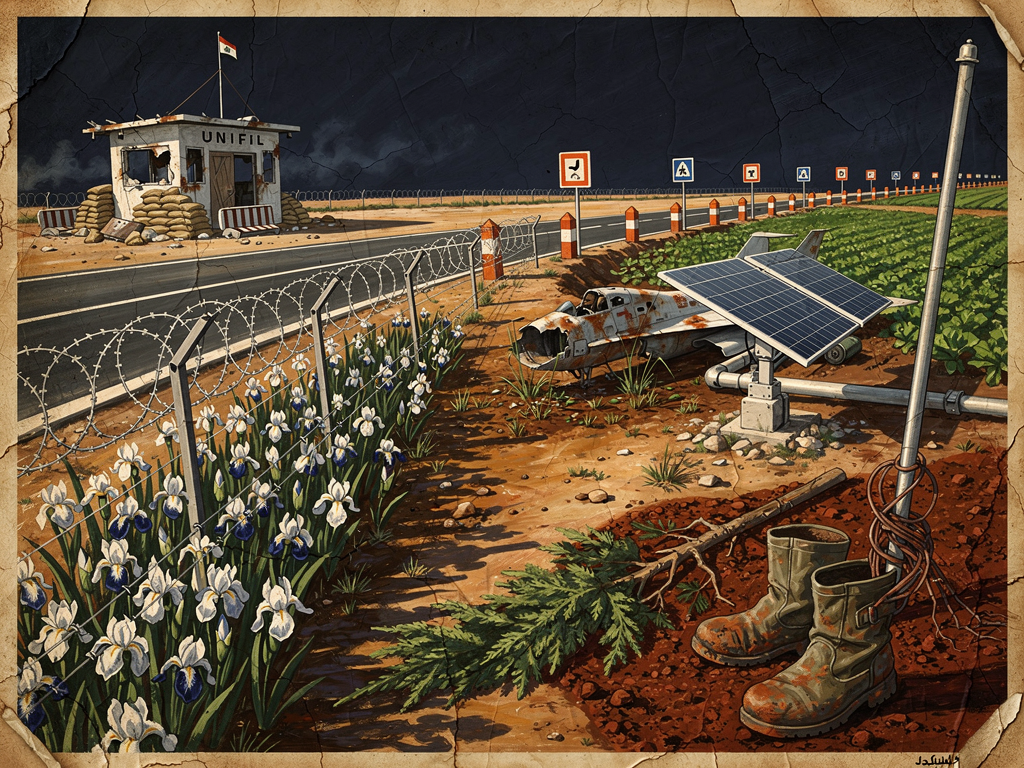
Operational Summary
A coordinated narrative has emerged across Western and Israeli media outlets between April 18 and April 27, 2026, designed to normalize and justify Israel’s sustained military presence in southern Lebanon. The operation spans 36 articles in 13 outlets, framing Israeli attacks as defensive responses to Hezbollah activity, while minimizing or omitting the implications of territorial occupation and civilian casualties.Article Timeline
When articles appeared, colored by manipulation score.
Narrative Architecture
The narrative consistently emphasizes Israeli 'freedom of action' and the necessity of preemptive strikes to neutralize threats. Articles selectively use terms like 'terrorists' and 'Hezbollah facilities' to categorize all casualties without evidentiary basis, reinforcing an us-versus-them dichotomy. The death of an Israeli soldier is presented as a provocation demanding military response, while civilian deaths in Lebanon are reported as collateral with no legal or moral scrutiny.Strategic omissions dominate. No article questions the legality of Israeli incursions beyond recognized borders. The term 'buffer zone' appears without context, evading its function as a euphemism for de facto annexation. Ceasefire violations are framed as mutual, obscuring asymmetry: Israel maintains offensive capability and initiative, while Hezbollah is portrayed as the sole aggressor regrouping during pauses. This reframing supports territorial consolidation under the guise of security.
Emotional levers are deployed asymmetrically. Israeli losses are detailed with specificity—names, ranks, family reactions—producing moral urgency. Lebanese deaths are aggregated: '14 killed, including women and children'—a formula that registers horror without humanizing victims. The affective imbalance steers audience empathy toward Israel, legitimizing escalation as moral necessity.
The IDF is consistently positioned as reactive. Actions are described as 'thwarting attempts' or 'responding to drone attacks'—language implying Israeli operations are dictated by external threats, not policy. This negates agency: Israel does not initiate; it corrects. The narrative structure thus absolves Israel of strategic responsibility while presenting military action as spontaneous and inevitable.
Cross-Outlet Coordination Pattern
The coordination spans pro-Israel outlets (Israel National News), Western mainstream media (The Guardian, CBC), and adversarial platforms (RT), suggesting a broad information containment strategy. Coverage from Israel National News and Ynet News promotes uncritical defense of IDF actions. RT and CBC adopt a 'balanced' tone—acknowledging Israeli strikes while noting Hezbollah attacks—yet still accept the premise of Israeli operational legitimacy.Notable alignment exists in phrasing: multiple outlets use 'freedom of action,' 'buffer zone,' and 'ceasefire violations' to describe Israel’s posture, despite divergent editorial leanings. The Guardian and CBC, while reporting higher civilian tolls, refrain from challenging Israel’s right to operate in Lebanese territory—an absence indicative of normative acceptance, not journalistic neutrality.
RT’s inclusion is strategic. By reporting Israeli casualties and framing Hezbollah actions as escalatory, RT reinforces the conflict-as-reciprocal model, even as it criticizes Israeli strikes. This enables the core narrative to withstand scrutiny from adversarial sources: if even RT accepts the premise of mutual violation, the framing gains credibility.
Outlets exhibiting higher coordination: